I am at an interesting place in life. I suppose we always are, but some moments, some situations seem particularly full of possibilities, like that time after high school when life stretches before you and nothing seems certain and nothing seems impossible and of course you're going to do it right the way your parents didn't. Fifty-two seems to be one of those times. My daughter is graduating high school, close to embarking on her own. I still have good years of work left and my creativity is at a steady burn. I could move and taste life at another place, let that geography soak into my being and alter me. I could still do many things. My cup is still more than half full, or at least could be.
That was my state of mind when I picked my cards, one for the reading and another to clarify. The way isn't clear ahead (when is the way ever really clear), so I've been peering into the mist, trying to discern where I might be headed. So the Three of Wands is actually an interesting and appropriate card being, as it is, a card of foresight and leadership. This is a man who stands on the cliff edge like the Fool, but leaps in full knowledge of what he wants and the price. The Three of Wands moves fearlessly into new areas, boards the distant ships and sails boldly wherever they are headed. That tells me that I will have to leap not knowing where I'm headed. I will have to have faith in myself, in the inherent goodness of life, in the belief that whatever and wherever life takes me, I'm exactly where I need to be. I couldn't have done it before my heart attack and bypass surgery, but I think I can do it now.
I probably didn't need to pick a second card. I actually didn't pick it; it picked me. The Three of Pentacles is about teamwork, planning, and competence. This is actually a good reminder for me that life is a collaboration and futures are made hand in hand. It also requires some planning, although, that said, it would be a mistake to think we could plan exactly where we are headed and how we will get there. Still, God helps those who help themselves. I need to be ready for the coming future, so I can leap fearlessly. I need to plan and prepare for my future, for it is coming.
May I be ready.
Friday, March 11, 2011
Tuesday, March 1, 2011
Tuesday, March 1, 2011 - The Ten of Cups
Today I got a "precautionary" pink slip. I knew it was coming but that didn't make it easier when it came. And I found myself near tears again and again, not because I don't think I'll find some work, but because the last few years have been hard and I wanted work, at least not to be. That said, I will confess I continue to have difficulty with change. Even knowing change is inevitable, irrevocable, doesn't make me hold on to things I want any less tightly. You'd think I'd have gotten used to keeping a loose grasp; you'd think I'd be prepared to have things ripped from my hand for no better reason than because. Alas, no. I hold to friends, love, and apparently to work long past done.
So I turned to the cards when I had a bit of distance and perspective and this is what I drew - the ten of cups. When this card shows up in a reading, it often signals a time of abundant blessings. It tells you to reach for the blessings you deserve and they will come to you. This is a card of peace, joy, and family. All in all, not a bad card but a reminder, I think, of what is important. The job is good; I like it, and it helps give us what we need as a family but it's not the most important. That was the thing, sitting problem solving at home this afternoon; it all boiled down to we will make it work, regardless.
The ten of cups reminds us that joy is our birthright. It was a good reminder on a day like today.
So I turned to the cards when I had a bit of distance and perspective and this is what I drew - the ten of cups. When this card shows up in a reading, it often signals a time of abundant blessings. It tells you to reach for the blessings you deserve and they will come to you. This is a card of peace, joy, and family. All in all, not a bad card but a reminder, I think, of what is important. The job is good; I like it, and it helps give us what we need as a family but it's not the most important. That was the thing, sitting problem solving at home this afternoon; it all boiled down to we will make it work, regardless.
The ten of cups reminds us that joy is our birthright. It was a good reminder on a day like today.
Tuesday, February 8, 2011
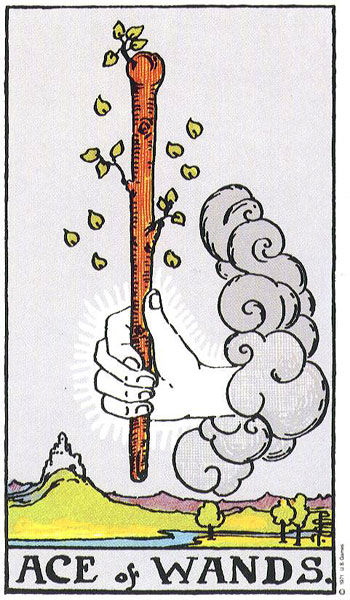
February 7, 2011 - The Ace of Wands
Any time an Ace comes up in a ready, it signals a time of beginnings, of potential, of seeds planted. There are no guarantees with Aces, just possibilities. They require you to be active, to do your part if you ever hope to see the potential come to fruition. For anyone who gardens, you know there's a lot between planting seeds and harvesting crops.
Wands as a suit are about action and energy, creativity and courage. When the Ace of Wands shows up in a reading, it urges you to tap into and utilize your creative force. Expand your potential, create a better way, come up with a solution, express yourself, open, unfold, do. Make the staff of you bud and branch. The life force runs strong in you.
This card also encourages enthusiasm. You feel eager and fired up. There's an aura of excitement around you that is inspiring to those around you. You are ready to tackle the world and those around you just might do the same when exposed to your infectious enthusiasm.
When the Ace comes in a reading, you are confident and courageous, or you should be. You believe in yourself and therefore are willing to tackle challenges and tasks that seem beyond your limit. Want to write a book? With the Ace in your court, you could make it happen. Of course it does require you to take the initiative, to actually write, to apply yourself, get the skills you need to make it happen. It's not offered on a silver platter. If you get it, you know you deserved it.
Here's what Joan Bunning writes about the Ace of Wands on learntarot.com: "When you see this Ace, examine your life to see how its potent, confident energy could work for you. Be daring and brave. Sometimes you have to risk to get what you want. Look for the path that will excite you and push you beyond your limits. Seize the initiative, and let your enthusiasm take you to new heights. Wands are the suit of individual power and fulfillment. This Ace tells you that a time of passion is beginning. You will be able to assert your best for all to see.
The Ace of Wands is also the card of creativity. Under its influence, you can become a conduit for inspiration and invention. Forget tired, worn-out solutions. You have the chance to be original. Trust your own creative potential, and there will be no end to what you can achieve."
Sounds pretty auspicious. Now it's up to me to make it so.
Wands as a suit are about action and energy, creativity and courage. When the Ace of Wands shows up in a reading, it urges you to tap into and utilize your creative force. Expand your potential, create a better way, come up with a solution, express yourself, open, unfold, do. Make the staff of you bud and branch. The life force runs strong in you.
This card also encourages enthusiasm. You feel eager and fired up. There's an aura of excitement around you that is inspiring to those around you. You are ready to tackle the world and those around you just might do the same when exposed to your infectious enthusiasm.
When the Ace comes in a reading, you are confident and courageous, or you should be. You believe in yourself and therefore are willing to tackle challenges and tasks that seem beyond your limit. Want to write a book? With the Ace in your court, you could make it happen. Of course it does require you to take the initiative, to actually write, to apply yourself, get the skills you need to make it happen. It's not offered on a silver platter. If you get it, you know you deserved it.
Here's what Joan Bunning writes about the Ace of Wands on learntarot.com: "When you see this Ace, examine your life to see how its potent, confident energy could work for you. Be daring and brave. Sometimes you have to risk to get what you want. Look for the path that will excite you and push you beyond your limits. Seize the initiative, and let your enthusiasm take you to new heights. Wands are the suit of individual power and fulfillment. This Ace tells you that a time of passion is beginning. You will be able to assert your best for all to see.
The Ace of Wands is also the card of creativity. Under its influence, you can become a conduit for inspiration and invention. Forget tired, worn-out solutions. You have the chance to be original. Trust your own creative potential, and there will be no end to what you can achieve."
Sounds pretty auspicious. Now it's up to me to make it so.
Friday, February 4, 2011
February 5, 2011 - The King of Wands
When Kings arrive in a reading it is often a call to act as he would. Coming on the heels of The High Priestess, a card of waiting, patience, and letting things unfold, it's an interesting draw. Wands are a fire sign, so the King of Wands is all about active expression of the traits of Wands.
The King of Wands is creative. He possesses natural artistic abilities which he uses for useful purposes. He is original and inventive. This King is also inspiring. A natural leader, he instills confidence and sets an example for others to follow. He is also forceful, charismatic and bold. It's easier to imagine myself The High Priestess then this outgoing King.
So what does the King mean for me? Is there a person in my life that expresses him- or herself like this king? Are there actions this King takes, that I should? Maybe. Hard to know. Last night I received the following fortune: You are often unaware of the effect you have on others. Maybe I am the King, sometimes at least, and just don't know it.
In the Jane Austen Tarot, the King of Wands is depicted by Frederick Wentworth, the dark haired hero of Persuasion. By the time Anne Elliot and Captain Wentworth meet after a long absence, Anne is a spinster and Wentworth is a successful Naval officer. Captain Wentworth has not forgiven Anne for rejecting his offer of marriage years before, when he was a young seaman with unsure prospects. And although he still loves Anne, he finds it difficult to let go of his anger and forgive her. This King's journey then is one of impulsiveness tempered by time, an older but wiser man who is not so stubborn to give up a chance at true love simply for the sake of his pride.
This King of Candlesticks (Wands) makes sense to me. I too am older and wiser and lately have been given the opportunity to forgive if not forget, to love instead of hate, to stay open when instinct tells me to retreat, to close. This card then is the reminder of what's at stake and how one sometimes must let go of anger and hurt in order to love truly and well, and live truly and well. At this age, I find that living and loving well are noble pursuits, ones I don't mind pursuing. I'm not so interested in anger and grudges, in the kind of fairness that is strictly measured as this much and this only.
Frederick Wentworth is also a creative man. Not an artist per se, he does understand the art of living and he has made himself what he is. He is a motivated and enthusiastic man, getting things done. In the midst of writing a novel and exploring and expanding my collage, not to mention being a mom and working full time, I need this King's energy and enthusiasm to get things done.
The King of Wands then is a good card, an important reminder of a different way to look at myself, a different way to be, active in the world, striking forth when it is warranted, waiting patiently when that better serves.
The King of Wands is creative. He possesses natural artistic abilities which he uses for useful purposes. He is original and inventive. This King is also inspiring. A natural leader, he instills confidence and sets an example for others to follow. He is also forceful, charismatic and bold. It's easier to imagine myself The High Priestess then this outgoing King.
So what does the King mean for me? Is there a person in my life that expresses him- or herself like this king? Are there actions this King takes, that I should? Maybe. Hard to know. Last night I received the following fortune: You are often unaware of the effect you have on others. Maybe I am the King, sometimes at least, and just don't know it.
In the Jane Austen Tarot, the King of Wands is depicted by Frederick Wentworth, the dark haired hero of Persuasion. By the time Anne Elliot and Captain Wentworth meet after a long absence, Anne is a spinster and Wentworth is a successful Naval officer. Captain Wentworth has not forgiven Anne for rejecting his offer of marriage years before, when he was a young seaman with unsure prospects. And although he still loves Anne, he finds it difficult to let go of his anger and forgive her. This King's journey then is one of impulsiveness tempered by time, an older but wiser man who is not so stubborn to give up a chance at true love simply for the sake of his pride.
This King of Candlesticks (Wands) makes sense to me. I too am older and wiser and lately have been given the opportunity to forgive if not forget, to love instead of hate, to stay open when instinct tells me to retreat, to close. This card then is the reminder of what's at stake and how one sometimes must let go of anger and hurt in order to love truly and well, and live truly and well. At this age, I find that living and loving well are noble pursuits, ones I don't mind pursuing. I'm not so interested in anger and grudges, in the kind of fairness that is strictly measured as this much and this only.
Frederick Wentworth is also a creative man. Not an artist per se, he does understand the art of living and he has made himself what he is. He is a motivated and enthusiastic man, getting things done. In the midst of writing a novel and exploring and expanding my collage, not to mention being a mom and working full time, I need this King's energy and enthusiasm to get things done.
The King of Wands then is a good card, an important reminder of a different way to look at myself, a different way to be, active in the world, striking forth when it is warranted, waiting patiently when that better serves.
February 1, 2011 - The High Priestess
Just back from the Santa Barbara Film Festival, this was the card I drew. It was an interesting weekend, to say the least. I spent a day with my past, and there weren't tears, and there wasn't passion, at least not the young passion there had been years ago. I was present but detached, there and yet observing. I guess you could say I was the High Priestess, not making things happen but glorying in each unfolding moment.
When the High Priestess arrives in a reading she heralds a time of inaction. We live in a culture which values action, doing, expression. The cycle of movement is contraction and extension; the cycle of respiration is inspiration and expiration, but in each of these active cycles, comes moments of pause, of rest. She counsels patience, the High Priestess. She tells you good things come to those who wait and that sometimes "desires can be realized through the stillness that gives desire a chance to flower within the fullness of time" (Joan Bunning, learntarot.com). Waiting and patience are not my strong suit. Life, though, has shown me 'grandmotherly kindness' these past few years, rapping me often with a hard stick the way Zen masters do to make a point, to move us out of complacency. I'm learning a glorious patience and a a marvelous stillness.
The High Priestess suggests it is time to use our intuition, to trust your inner voice, to open to dreams and the imagination. I've been quieting these past couple of years, trying to hear the small, still voice inside. It struck me this last weekend that I hear that still voice loud and clear these days. I have come to the High Priestess place, backed into it you could say. So now what?
I'm thinking she's here to tell me to open to what could be, to wait, to watch, to look deeper, to settle into the unknown and to let it unfold. No pushing. No making something happen, or trying to. That's all illusion anyway. As I wrote to a friend recently, he in the thick of his 'interesting times,' at best we collaborate with life or it with us, at worst we are swept away like Odysseus with only our faith and Ina's scarf between us and the sea.
So I will be the High Priestess and whatever other card comes as I take this journey. I'll sit, steeped in mystery, and let whatever is there flower.
When the High Priestess arrives in a reading she heralds a time of inaction. We live in a culture which values action, doing, expression. The cycle of movement is contraction and extension; the cycle of respiration is inspiration and expiration, but in each of these active cycles, comes moments of pause, of rest. She counsels patience, the High Priestess. She tells you good things come to those who wait and that sometimes "desires can be realized through the stillness that gives desire a chance to flower within the fullness of time" (Joan Bunning, learntarot.com). Waiting and patience are not my strong suit. Life, though, has shown me 'grandmotherly kindness' these past few years, rapping me often with a hard stick the way Zen masters do to make a point, to move us out of complacency. I'm learning a glorious patience and a a marvelous stillness.
The High Priestess suggests it is time to use our intuition, to trust your inner voice, to open to dreams and the imagination. I've been quieting these past couple of years, trying to hear the small, still voice inside. It struck me this last weekend that I hear that still voice loud and clear these days. I have come to the High Priestess place, backed into it you could say. So now what?
I'm thinking she's here to tell me to open to what could be, to wait, to watch, to look deeper, to settle into the unknown and to let it unfold. No pushing. No making something happen, or trying to. That's all illusion anyway. As I wrote to a friend recently, he in the thick of his 'interesting times,' at best we collaborate with life or it with us, at worst we are swept away like Odysseus with only our faith and Ina's scarf between us and the sea.
So I will be the High Priestess and whatever other card comes as I take this journey. I'll sit, steeped in mystery, and let whatever is there flower.
Wednesday, January 26, 2011
January 26, 2011 - The Five of Wands
I'm getting ready to head down to Santa Barbara for their film festival. Santa Barbara is a place of my greatest joys and deepest sorrows, a place of dreams and hopes, haunting, lovely and terribly problematic, for me. I keep going there for many reasons. It inspires me, fills my heart. There are good friends there. And the place itself calls to me as strongly as any person. My first love is there; perhaps my first love is Santa Barbara and he, is the second, the embodiment of the place.
Sometimes when I find myself in Santa Barbara, I see my first love. We are "friends" or we try to be. It is a relationship that is problematic for me, but psychologically rich so I keep working it as it keeps working me. It seems I may see him this trip, my first love. Of course, it is just as likely I won't. This is part of our dance, the on and off, ebb and flow of us. Most of me is sanguine, finally, although there is a part of me, still, that frets and fusses over the yes and no, he will or won't. So I asked the cards what I should I keep in mind this trip, if we meet. The Five of Wands came (the Five of Candlesticks in the Jane Austen Tarot).
The Five of Wands, like most fives in the Tarot, is about struggle. Looking at the young men sparring, this isn't a full-out, knock down, drag out battle. It's a minor skirmish, which doesn't mean that you won't get hurt. The Five of Wands is one of those days where nothing seems to go right, where a dozen small annoyances make for one very bad day. It's a card of quarreling, competition, and hassles. I'm thinking this is not a particularly auspicious card for this visit. Oh well. These days I'm a wait and see kind-of gal, so we'll do just that, wait and see what comes.
Sometimes when I find myself in Santa Barbara, I see my first love. We are "friends" or we try to be. It is a relationship that is problematic for me, but psychologically rich so I keep working it as it keeps working me. It seems I may see him this trip, my first love. Of course, it is just as likely I won't. This is part of our dance, the on and off, ebb and flow of us. Most of me is sanguine, finally, although there is a part of me, still, that frets and fusses over the yes and no, he will or won't. So I asked the cards what I should I keep in mind this trip, if we meet. The Five of Wands came (the Five of Candlesticks in the Jane Austen Tarot).
The Five of Wands, like most fives in the Tarot, is about struggle. Looking at the young men sparring, this isn't a full-out, knock down, drag out battle. It's a minor skirmish, which doesn't mean that you won't get hurt. The Five of Wands is one of those days where nothing seems to go right, where a dozen small annoyances make for one very bad day. It's a card of quarreling, competition, and hassles. I'm thinking this is not a particularly auspicious card for this visit. Oh well. These days I'm a wait and see kind-of gal, so we'll do just that, wait and see what comes.
Tuesday, January 25, 2011
January 24, 2011 - Ace of Cups
I love this card. There is so much peace in it, so much hope. Sure, like all Aces it holds the idea, the seed, the possibility, in this case of deep emotions, intuition, intimacy, compassion and love. And yes, this card, like all the cards, requires us to use our gifts, to make the effort. Tarot is never sure, never Fate, at least in my understanding of it. Tarot reminds us that life collaborates with us every step of the way. We bring our gifts, and maybe we get the promised prize. Of course, we must always be open to what may come and how it may come. So many times we are so sure how the story will play out and surprisingly find ourselves in another story entirely. The key seems to be this: Be open.
When the Ace of Cups arrives in a reading, it suggests the emotional and intuitive realms are at the fore. The seeds have been planted but what grows, if anything, depends on you. Many get this card and think 'new love.' And yes, it could mean that, but it doesn't have to. Any part of the emotional realm is under this card's provenance. So be prepared. Look at your life and see how its emotional energy can work for you. Maybe it is a new love. Maybe it is forgiveness, of yourself or another. Perhaps it's time to reach out and connect with others. Or it could be that it is time for you to drop your reserve and let your feelings show. Only you will know what this card means and it requires that you practice patience and self-reflection.
Friday, January 21, 2011
January 20, 2011 - The Six of Wands
The Six of Wands is a card of triumph, acclaim, and pride. It is the minor arcana counterpart of the Chariot. When this card shows up in a reading, you have been working hard toward a goal and success is within reach. The thing is, I asked my usual question, "What do I need to know today, that will help me move along my path toward my higher good?" Of course there's always a subtext, even to these general questions. There are yearnings and hopes, joys and sorrows, regrets, all of us have a few. So how to tease out what is the battle, what is the victory? I should be celebrating, but why? And maybe it doesn't matter, the what and the why, but knowing that there is struggle and success, that the wheel turns and turns and turns.
Sometimes in Tarot the answers are unclear. Usually that is because the question is unclear although I think there is something in Tarot like there is in the Runes, the blank Rune that says it's in hands of the gods and only they can know for now. It is a fated point. Maybe this is where I am, or maybe I do know. Or maybe it is all just wishful thinking.
If you're confused about a card, you can restate your question, or clarify it, and then choose another card. This I did and received the Lovers. The Lovers is a card about relationships. It is also a card of choices. I think I know what the battle is, but I still don't know what success and triumph means. I have hopes, sure, but they're just future and fantasy. Since my heart surgery, I'm a lot more present tense, more content to let triumph unfold, to see the future unfold, not to project my desires.
Tarot can give clear enough answers, in the beginning. As you work with it longer, the answers grow deeper, more multi-faceted. I think for me, I've been working with it long enough that we've become old friends in a deep conversation. Which means I'm going to wait and see what comes.
Sometimes in Tarot the answers are unclear. Usually that is because the question is unclear although I think there is something in Tarot like there is in the Runes, the blank Rune that says it's in hands of the gods and only they can know for now. It is a fated point. Maybe this is where I am, or maybe I do know. Or maybe it is all just wishful thinking.
If you're confused about a card, you can restate your question, or clarify it, and then choose another card. This I did and received the Lovers. The Lovers is a card about relationships. It is also a card of choices. I think I know what the battle is, but I still don't know what success and triumph means. I have hopes, sure, but they're just future and fantasy. Since my heart surgery, I'm a lot more present tense, more content to let triumph unfold, to see the future unfold, not to project my desires.
Tarot can give clear enough answers, in the beginning. As you work with it longer, the answers grow deeper, more multi-faceted. I think for me, I've been working with it long enough that we've become old friends in a deep conversation. Which means I'm going to wait and see what comes.
January 18, 2011 - The Queen of Wands
Sometimes I have burning questions that I ask the Tarot. Sometimes I have burning questions I don't ask the Tarot. And sometimes, I don't yet have a specific question and so I just ask for guidance, which is what I did tonight.
I will say, like many I know, I am in the midst of transformation. I am unfolding and have no idea where I'm headed. I joked to a friend tonight I should don a permanent sign, Under Construction. I may be 52, but I'm still becoming.
So what does it mean when the Queen of Wands comes for a visit? Court cards can refer to particular people who embody the traits, in this case, an attractive, wholehearted, energetic, cheerful and self-assured being. They can also suggest a particular environment or atmosphere that would be good for you or one you should try to cultivate. Maybe these are qualities you need to embody. Or perhaps, they are qualities you have but don't recognize. The key with court cards, I'm finding, is just to listen.
I have come over the years to like this Queen of Fire. My she is self-assured. I am growing into that, in some ways, and in others still I'm still lacking. She is described as appealing and popular. It is said she creates a powerful first impression. These are not words I would use to describe myself, although maybe it's time I learned. I'm thinking maybe the Queen is telling me to shake off my blues and adopt a sunnier disposition. She is encouraging me to let my light shine and to know myself beautiful inside and out. I once had a dream of woman growing lighter, brighter as she became herself and by the end she was so bright and so beautiful, I didn't care about the rest of the dream, I only wanted to be just like her, my soul clear and shining, bright and beautiful, myself completely. I think I am heading there, slowly but surely.
Those of you who have been reading my blogs know I've been working with the Jane Austen Tarot. It seems to be a gentle, hopeful deck, the perfect deck for me these days. In the Jane Austen Tarot, the Queen of Wands (Lady of Candlesticks) is Elizabeth Bennett, the heroine of Pride and Prejudice. At the beginning of the novel, Lizzie is the Maiden. Time though, and experience her burnish her into the Lady. The Queen cards in tarot suggest that the strengths of the suit have been embodied. Elizabeth doesn't just act out the attributes of integrated wands, she embodies them.
There was a time when I wanted to be Elizabeth Bennett. Vivacious, self-possessed, smart, pretty, observant, with a quick wit, she was the best I could imagine to be. She had a honoring connection with her father. Her relationship with her mother was exasperated but accepting, even loving in its way. She found love and companionship, respectful and passionate. He was her equal and she his. That was my dream of love, maybe still is. Nowadays, I have more in common with Anne Elliot of Persuasion, Austen's only older and wiser heroine, her last. Anne is nearly past hope, nearly an Old Maid, and yet there's a part of her that still hopes, that blossoms like a flower when that hope is sparked.
But today, it's Elizabeth Bennett and maturing into a wise and warm Lady of Candlesticks. She still inspires me, this Queen of Wands. And I still find there's a part of me that dreams of Elizabeth Bennett and her happily ever after.
I will say, like many I know, I am in the midst of transformation. I am unfolding and have no idea where I'm headed. I joked to a friend tonight I should don a permanent sign, Under Construction. I may be 52, but I'm still becoming.
So what does it mean when the Queen of Wands comes for a visit? Court cards can refer to particular people who embody the traits, in this case, an attractive, wholehearted, energetic, cheerful and self-assured being. They can also suggest a particular environment or atmosphere that would be good for you or one you should try to cultivate. Maybe these are qualities you need to embody. Or perhaps, they are qualities you have but don't recognize. The key with court cards, I'm finding, is just to listen.
I have come over the years to like this Queen of Fire. My she is self-assured. I am growing into that, in some ways, and in others still I'm still lacking. She is described as appealing and popular. It is said she creates a powerful first impression. These are not words I would use to describe myself, although maybe it's time I learned. I'm thinking maybe the Queen is telling me to shake off my blues and adopt a sunnier disposition. She is encouraging me to let my light shine and to know myself beautiful inside and out. I once had a dream of woman growing lighter, brighter as she became herself and by the end she was so bright and so beautiful, I didn't care about the rest of the dream, I only wanted to be just like her, my soul clear and shining, bright and beautiful, myself completely. I think I am heading there, slowly but surely.
Those of you who have been reading my blogs know I've been working with the Jane Austen Tarot. It seems to be a gentle, hopeful deck, the perfect deck for me these days. In the Jane Austen Tarot, the Queen of Wands (Lady of Candlesticks) is Elizabeth Bennett, the heroine of Pride and Prejudice. At the beginning of the novel, Lizzie is the Maiden. Time though, and experience her burnish her into the Lady. The Queen cards in tarot suggest that the strengths of the suit have been embodied. Elizabeth doesn't just act out the attributes of integrated wands, she embodies them.
There was a time when I wanted to be Elizabeth Bennett. Vivacious, self-possessed, smart, pretty, observant, with a quick wit, she was the best I could imagine to be. She had a honoring connection with her father. Her relationship with her mother was exasperated but accepting, even loving in its way. She found love and companionship, respectful and passionate. He was her equal and she his. That was my dream of love, maybe still is. Nowadays, I have more in common with Anne Elliot of Persuasion, Austen's only older and wiser heroine, her last. Anne is nearly past hope, nearly an Old Maid, and yet there's a part of her that still hopes, that blossoms like a flower when that hope is sparked.
But today, it's Elizabeth Bennett and maturing into a wise and warm Lady of Candlesticks. She still inspires me, this Queen of Wands. And I still find there's a part of me that dreams of Elizabeth Bennett and her happily ever after.
Saturday, November 27, 2010
November 27, 2010 - Judgement
When a Major Arcana card comes up in a reading, you're supposed to pay attention. It means that whatever is happening is transformational, life-changing, important for your path. Since I don't always articulate questions when I pull a card (of course there is always the unstated, I'm realizing more and more, things left unspoken but not, it seems, unvisited), it gives me a bit of wiggle room when trying to figure it out. At least that's what I tell myself.
The scene depicted on the Judgement card is Judgement Day. The angel of the Lord is calling forth the dead. Those that are worthy will rise to heaven and those that are not .... Well, let's just say most organized religions urge you not to be found unworthy. I never quite know how I feel when this card comes up. Sometimes judgment is necessary. You have to commit yourself and decide. Sometimes we are judged, fairly and unfairly. It is a card of salvation. The past is forgiven and you receive your just rewards. It would be nice if we made it through life without mistakes, without hurting people, without being less than what we are and what we can be. It's nice to know that we can be forgiven those trespasses and have our fresh start.
So what does it mean when this card comes up in a reading Well, it can mean a day of reckoning is at hand. It may also mean that all the waffling has to stop; that a decision needs to be made and stuck with. I'm big on waffling. I don't end things well, especially when I don't want things to end. Sometimes though you do have to end things. I keep wondering if Judgement shows up to remind me of the things that are lingering, the ones I haven't taken care of. Another aspect of the card is salvation and redemption. It could mean that it's time for a fresh start and that a fresh start is possible. It could signal a time of renewed hope as well as a time to discover joy. That would be nice, the renewed hope and discovering joy part.
In the Jane Austen Tarot, this card depicts the characters of Jane Austen's novel, Emma - Emma and Mr. Knightley; Mrs. Weston; Mr. Woodhouse; and Harriet Smith. By the end of the book, each of these characters is ready for transformation, for the next level in his or her development. George Knightley and Emma are deeply in love and engaged to be married; Mr. Woodhouse, a man who dreads change, is contemplating accepting it for his daughter's sake and his own. Harriet Smith, a young woman of unknown parentage, has fallen in love multiple times and fallen out of it just as easily, and at last finds herself back where she started, with a proposal from Robert Martin. Mrs. Weston, Emma's old governess, has married a gentleman and is expecting her first child. Her life has changed and is going to change again from wife to mother.
What I like about the pairing of this novel and the card is how it demonstrates something critical about this card. Transformation requires action of us. Each of these characters had to make a choice, a judgment, and then act on it. Fate didn't drop a happy ending in his or her lap. Each of them had to act, to know what he or she wanted, and work towards it, trusting it would come. This is the lesson I am taking from the Judgement card today.
The scene depicted on the Judgement card is Judgement Day. The angel of the Lord is calling forth the dead. Those that are worthy will rise to heaven and those that are not .... Well, let's just say most organized religions urge you not to be found unworthy. I never quite know how I feel when this card comes up. Sometimes judgment is necessary. You have to commit yourself and decide. Sometimes we are judged, fairly and unfairly. It is a card of salvation. The past is forgiven and you receive your just rewards. It would be nice if we made it through life without mistakes, without hurting people, without being less than what we are and what we can be. It's nice to know that we can be forgiven those trespasses and have our fresh start.
So what does it mean when this card comes up in a reading Well, it can mean a day of reckoning is at hand. It may also mean that all the waffling has to stop; that a decision needs to be made and stuck with. I'm big on waffling. I don't end things well, especially when I don't want things to end. Sometimes though you do have to end things. I keep wondering if Judgement shows up to remind me of the things that are lingering, the ones I haven't taken care of. Another aspect of the card is salvation and redemption. It could mean that it's time for a fresh start and that a fresh start is possible. It could signal a time of renewed hope as well as a time to discover joy. That would be nice, the renewed hope and discovering joy part.
In the Jane Austen Tarot, this card depicts the characters of Jane Austen's novel, Emma - Emma and Mr. Knightley; Mrs. Weston; Mr. Woodhouse; and Harriet Smith. By the end of the book, each of these characters is ready for transformation, for the next level in his or her development. George Knightley and Emma are deeply in love and engaged to be married; Mr. Woodhouse, a man who dreads change, is contemplating accepting it for his daughter's sake and his own. Harriet Smith, a young woman of unknown parentage, has fallen in love multiple times and fallen out of it just as easily, and at last finds herself back where she started, with a proposal from Robert Martin. Mrs. Weston, Emma's old governess, has married a gentleman and is expecting her first child. Her life has changed and is going to change again from wife to mother.
What I like about the pairing of this novel and the card is how it demonstrates something critical about this card. Transformation requires action of us. Each of these characters had to make a choice, a judgment, and then act on it. Fate didn't drop a happy ending in his or her lap. Each of them had to act, to know what he or she wanted, and work towards it, trusting it would come. This is the lesson I am taking from the Judgement card today.
November 26, 2010 - The Lady of Coins (Queen of Pentacles)
Another court card; so what else is new. When court cards appear certain character traits are highlighted. In the case of the Queen of Pentacles you are talking about someone who is down-to-earth, nurturing, bighearted, resourceful and trustworthy. Are these me? Or are these qualities I need to embody? Perhaps this is the atmosphere I need to create? Or maybe this is someone in my life. The court cards are funny that way. People wrestle with them, trying to figure them out. At least I wrestle with them, trying to figure them out.
Since my time at Pacifica, I see them more as examples of Jung's typology. Jung believed that as we individuate we become more and more able to embody typological aspects that are not our more natural fits. Introverts become more extroverted, feelers can access their thinking function.
So what about Queen of Pentacles? She came on a family day when I was making a home Thanksgiving. It was a typical day with good and bad, highs and lows, ease and worry. My dog had eaten something bad and ended up sick. I could have over-reacted but remained calm and competent, caring but not crazed. The Queen of Pentacles is the kind of woman you want around when you are in trouble, hurt, fearful, worried. I hope I'm that kind of woman too, when I need to be. I think was the day this card arrived, meaning I was as I needed to be, but larger lessons? I'm just not sure. I guess I'll keep drawing cards and maybe someday the court cards will make sense to me. Until then, it's time to get the stock started, check on the dog, and try out that recipe with my daughter. I think that's what the Queen of Pentacles would do at any rate
Since my time at Pacifica, I see them more as examples of Jung's typology. Jung believed that as we individuate we become more and more able to embody typological aspects that are not our more natural fits. Introverts become more extroverted, feelers can access their thinking function.
So what about Queen of Pentacles? She came on a family day when I was making a home Thanksgiving. It was a typical day with good and bad, highs and lows, ease and worry. My dog had eaten something bad and ended up sick. I could have over-reacted but remained calm and competent, caring but not crazed. The Queen of Pentacles is the kind of woman you want around when you are in trouble, hurt, fearful, worried. I hope I'm that kind of woman too, when I need to be. I think was the day this card arrived, meaning I was as I needed to be, but larger lessons? I'm just not sure. I guess I'll keep drawing cards and maybe someday the court cards will make sense to me. Until then, it's time to get the stock started, check on the dog, and try out that recipe with my daughter. I think that's what the Queen of Pentacles would do at any rate
Wednesday, November 24, 2010
November 24, 2010 - The Lord of Candlesticks (King of Wands)
The court cards of each suit in the Tarot reflect mastery of the attributes of the suit, from the idealized optimism of the page to the mastery and expression of the king. Wands represent the element of fire. It is a suit of creativity, self- expression, entrepreneurship, and originality. When the King arrives in a reading, fire of fire, get ready. Here is someone who is honest, forthright, knows what he wants, and reaches out to make it happen. He is bold, daring, and confident. He has the courage of his convictions and always believes in himself.
So what does the King of Wands mean for me today? My question was not really a question, asked but not really asked after receiving an email from someone who has meant the world to me, perhaps still does, and has hurt my heart more often than I can count. It was a nice enough email, one that a even a year ago, might have made me happy, hopeful, but now brings a shrug and a wondering, 'so.' I can tell you I don't feel one bit like the King of Wands. There's no way I'm the center of attention, forceful in the pursuit of my goals, confident, a natural leader, bold and daring. Creative, sure, but the rest? The email reminds me of all I'm not, and then the King of Wands arrives to encourage me to be creative, inspiring, forceful, charismatic and bold. Can I be the King of Wands? Looks like I'm going to have to try.
Tuesday, November 23, 2010
November 23, 2010 - The Ten of Pentacles
Given that I was up early with money worries, selecting this card seems a bit ironic. In the Tarot, tens take the culmination of the nines and kick it up to the next level. You will find in the Tarot that as numbers repeat (e.g. 1 - The Magician; 10 - The Wheel of Fortune, and 20 - Judgment), you get different vibrations of a similar theme. The tens of the minor arcana echo The Wheel, with two of the tens (swords and wands) reflecting more negative fortunes while the other two (cups and pentacles), reflect more positive results.
Pentacles represent the element of earth. The suit is often referred to as "coins" and so it has to do with material gain and success. If you look at the card, you can see times are good. The couple is well dressed. The patriarch looks on in comfort, his red robes luxurious. Money is in the air. Just looking at the card suggests the ultimate in worldly and material success. If you are asking about your latest enterprise, this is the card you want to see.
The Ten of Pentacles is about enjoying affluence, being free from money problems, feeling financially secure. It suggests you might be in the midst of a run of good luck and your material ventures will flourish. Because pentacles represent the element of earth, they also refer to building foundations and following conventions. The Ten of Pentacles is about traditions, seeking permanence and success within the establishment. This is a status quo card. The key with the Ten of Pentacles is the understanding that to everything there is a season, a time to flow with change and a time to build foundations that will last. We need both to be successful in this life, foundation and flow, foundation and flow.
So what does it mean to pick this card on a day when I woke up too early with money worries? I think it means to create a firm foundation, to trust but to work for my financial security, to create a plan and then stick to it. Now maybe it means too I will be free of money problems, in a happy way. That's great, but I need to do my part. If God helps those that help themselves, then I better get cracking. If I do, maybe I'll get some sleep : )
Pentacles represent the element of earth. The suit is often referred to as "coins" and so it has to do with material gain and success. If you look at the card, you can see times are good. The couple is well dressed. The patriarch looks on in comfort, his red robes luxurious. Money is in the air. Just looking at the card suggests the ultimate in worldly and material success. If you are asking about your latest enterprise, this is the card you want to see.
The Ten of Pentacles is about enjoying affluence, being free from money problems, feeling financially secure. It suggests you might be in the midst of a run of good luck and your material ventures will flourish. Because pentacles represent the element of earth, they also refer to building foundations and following conventions. The Ten of Pentacles is about traditions, seeking permanence and success within the establishment. This is a status quo card. The key with the Ten of Pentacles is the understanding that to everything there is a season, a time to flow with change and a time to build foundations that will last. We need both to be successful in this life, foundation and flow, foundation and flow.
So what does it mean to pick this card on a day when I woke up too early with money worries? I think it means to create a firm foundation, to trust but to work for my financial security, to create a plan and then stick to it. Now maybe it means too I will be free of money problems, in a happy way. That's great, but I need to do my part. If God helps those that help themselves, then I better get cracking. If I do, maybe I'll get some sleep : )
November 22, 2010 - The World
The World is the last card of the Major Arcana. If the twenty-two cards of the Major Arcana represent the path of life, our human journey from the Fool's leap to culmination, then the World is this perfect end, the thanksgiving feast before we begin again. When it comes up in a reading, it's a good card. It's the kind of card you hope to get, telling you you've integrated, accomplished, reached your goal. This is the "Miller Time" card and yet why don't I feel better about it?
My question was the usual, "What do I need to know?" although at the care there is another pressing issue, this idea of moving on, of mastering the lessons of illness and death, of dwindling time and the need to make the most of it. I will admit to being a bit obsessed, especially since my dad's death, with "getting" what lessons I need to and "getting" on with life. I so want to see things in this black and white even though one of the lessons of the last few years has been shades of gray.
As those of you who read this blog know, I've been working with the Jane Austen Tarot. Every deck has its particular philosophy, and I resonate with Jane Austen - the relational focus, the pithy observations, and a world where connections and love drive our stories. Relating cards to stories has made it easier for me to understand the essence of certain cards even as I understand I am viewing the Tarot through a particular lens and bias. Another year and I might find myself taken with another deck; but for now, since many of my questions seem to be relational, this is the deck for me.
So back to the World. In the Rider-Waite deck we have a woman placed at the center of an oval. Now this figure is sometimes represented as an androgyne, a being both male and female, representing wholeness. This is reflected again by the oval, perhaps a laurel wreath, signifying triumph and being at the height of one's craft/field. In each of the four corners is a representation of each of the directions/elements, suggesting that with this card, we have mastered and are reflecting every element within us. Notice how the figure dances, light as a feather, perfectly balanced although never touching the ground. With this card then, we have achieved balance. Looking just at the imagery then, you don 't need to open a book to find the meaning. It's clear by just looking at the card. The tarot is often like this. You just have to begin to think symbolically.
Now let's get back to where I am, which is holding this amazing card and not feeling the least bit amazing myself. Do I feel whole, integrated, myself at last? Yes, but it is not a static process, at least for me. It is a constant becoming so even as I dance lightly in the air, I know I will take that step off the cliff, like the Fool, and begin again. In fact, I want to, not because I enjoy the fall as much as I know that life is to be lived and that every equinox tips us this way and that, depending. Do I feel accomplished? This is a card, after all, of realizing your goals, of prospering, of seeing your dreams come true. Yes, but each goal seems to lead to another goal and while I may be flourishing, I am still working on achieving my heart's desires. The World is also a card of healing and sharing what you have, of giving of yourself, of being fully engaged. Well, I am fully engaged, that's for sure, although that is not always a comfortable thing. And as for being fulfilled, savoring he moment and counting my blessings, well that to is ongoing. I tend to focus on what I don't have as opposed to what I do. Thank goodness this is the season of thanksgiving and thankfulness, encouraging me to go against my grain.
The thing about Tarot is that maybe you're going to get a definitive answer, but it's always going to be something you already knew if you paid attention to your own sure, still voice instead of giving in to the endless chatter inside your head and out. Mostly though, you're going to get reminders, and the cards are going to make you stop and think and perhaps, at last, understand yourself. When you act, you will act consciously and perhaps realizing for the first time why you are where you are and what you have to do if you want to find yourself some where different. And maybe you don't want to be anywhere different. Maybe you're happy just where you are and that's good to know too. Then you can savor the moment, count your blessings and find some contentment.
My question was the usual, "What do I need to know?" although at the care there is another pressing issue, this idea of moving on, of mastering the lessons of illness and death, of dwindling time and the need to make the most of it. I will admit to being a bit obsessed, especially since my dad's death, with "getting" what lessons I need to and "getting" on with life. I so want to see things in this black and white even though one of the lessons of the last few years has been shades of gray.
As those of you who read this blog know, I've been working with the Jane Austen Tarot. Every deck has its particular philosophy, and I resonate with Jane Austen - the relational focus, the pithy observations, and a world where connections and love drive our stories. Relating cards to stories has made it easier for me to understand the essence of certain cards even as I understand I am viewing the Tarot through a particular lens and bias. Another year and I might find myself taken with another deck; but for now, since many of my questions seem to be relational, this is the deck for me.
So back to the World. In the Rider-Waite deck we have a woman placed at the center of an oval. Now this figure is sometimes represented as an androgyne, a being both male and female, representing wholeness. This is reflected again by the oval, perhaps a laurel wreath, signifying triumph and being at the height of one's craft/field. In each of the four corners is a representation of each of the directions/elements, suggesting that with this card, we have mastered and are reflecting every element within us. Notice how the figure dances, light as a feather, perfectly balanced although never touching the ground. With this card then, we have achieved balance. Looking just at the imagery then, you don 't need to open a book to find the meaning. It's clear by just looking at the card. The tarot is often like this. You just have to begin to think symbolically.
Now let's get back to where I am, which is holding this amazing card and not feeling the least bit amazing myself. Do I feel whole, integrated, myself at last? Yes, but it is not a static process, at least for me. It is a constant becoming so even as I dance lightly in the air, I know I will take that step off the cliff, like the Fool, and begin again. In fact, I want to, not because I enjoy the fall as much as I know that life is to be lived and that every equinox tips us this way and that, depending. Do I feel accomplished? This is a card, after all, of realizing your goals, of prospering, of seeing your dreams come true. Yes, but each goal seems to lead to another goal and while I may be flourishing, I am still working on achieving my heart's desires. The World is also a card of healing and sharing what you have, of giving of yourself, of being fully engaged. Well, I am fully engaged, that's for sure, although that is not always a comfortable thing. And as for being fulfilled, savoring he moment and counting my blessings, well that to is ongoing. I tend to focus on what I don't have as opposed to what I do. Thank goodness this is the season of thanksgiving and thankfulness, encouraging me to go against my grain.
The thing about Tarot is that maybe you're going to get a definitive answer, but it's always going to be something you already knew if you paid attention to your own sure, still voice instead of giving in to the endless chatter inside your head and out. Mostly though, you're going to get reminders, and the cards are going to make you stop and think and perhaps, at last, understand yourself. When you act, you will act consciously and perhaps realizing for the first time why you are where you are and what you have to do if you want to find yourself some where different. And maybe you don't want to be anywhere different. Maybe you're happy just where you are and that's good to know too. Then you can savor the moment, count your blessings and find some contentment.
Monday, November 22, 2010
Return to Tarot - The Six of Cups
Every Tarot deck has it's own nuanced meaning. This is how the Six of Cups looks in the Rider-Waite deck. By just looking at it, you get a good feel for what the card is about. Not every card speaks so clearly, but this one does.
So what do you see? Two children. One, an older boy is giving flowers to the young girl. The flowers are white, the color of purity and innocence and shaped like a star, referring back to the Major Arcana card, The Star, the card of hopes and dreams. There is a sense of nostalgia to this card and innocence. It can be a card of children or a card of childhood. It is always a card of simple goodness and encourages us to be our best - kind, generous and forgiving.
Now like any card, the Six of Cups has a darker side. The innocence of this card can reflect a state of denial or blinding ourselves to the worst of a situation. It can also mean we are being deceived.
So what does it mean? Well, this is where interpretation comes in. I'm encouraging you to begin to have conversations with your cards. They will not always speak clearly or tell you what you should do. For example, there are a few people in my life that do not honor me as I would like them too. My question was about them. They are silent for long periods and make contact only when it serves them. So when I ask, "What do I do?" and the six of cups comes up I have to sit with the card and begin to consider my course. Am I being deceived or trusting them too childishly? Maybe once but I am clear now and understand better how our relationship flows. Do I forgive them and continue as before? Probably not. Once your eyes are open, can you ever not see what you have seen? I can forgive but let them go. I can forgive and ask more of them and hope they rise to the occasion. I can wait and see what unfolds, seeing clearly and trying to remain detached from the outcome. I'm choosing, based on this card, to do all three.
To be honest, I no longer want relationships without mutual respect. I want to honor and be honored. And I suspect with this new attitude, relationships that no longer serve will fall away. Not without struggle of course, I am, after all, only human.
As you can see, in one way, this answer was crystal clear, but in another, wasn't. For me at least, tarot is like that, a wonderful friend with sharp and loving insight, if I will only listen.
So what do you see? Two children. One, an older boy is giving flowers to the young girl. The flowers are white, the color of purity and innocence and shaped like a star, referring back to the Major Arcana card, The Star, the card of hopes and dreams. There is a sense of nostalgia to this card and innocence. It can be a card of children or a card of childhood. It is always a card of simple goodness and encourages us to be our best - kind, generous and forgiving.
Now like any card, the Six of Cups has a darker side. The innocence of this card can reflect a state of denial or blinding ourselves to the worst of a situation. It can also mean we are being deceived.
So what does it mean? Well, this is where interpretation comes in. I'm encouraging you to begin to have conversations with your cards. They will not always speak clearly or tell you what you should do. For example, there are a few people in my life that do not honor me as I would like them too. My question was about them. They are silent for long periods and make contact only when it serves them. So when I ask, "What do I do?" and the six of cups comes up I have to sit with the card and begin to consider my course. Am I being deceived or trusting them too childishly? Maybe once but I am clear now and understand better how our relationship flows. Do I forgive them and continue as before? Probably not. Once your eyes are open, can you ever not see what you have seen? I can forgive but let them go. I can forgive and ask more of them and hope they rise to the occasion. I can wait and see what unfolds, seeing clearly and trying to remain detached from the outcome. I'm choosing, based on this card, to do all three.
To be honest, I no longer want relationships without mutual respect. I want to honor and be honored. And I suspect with this new attitude, relationships that no longer serve will fall away. Not without struggle of course, I am, after all, only human.
As you can see, in one way, this answer was crystal clear, but in another, wasn't. For me at least, tarot is like that, a wonderful friend with sharp and loving insight, if I will only listen.
Monday, September 6, 2010
Open Letters To People Or Entities Who Are Unlikely To Respond....
Dear Professor,
Which got me thinking about who/what I would write an open letter to. This old flame and perhaps friend? Maybe. But I'm thinking that he is a particular, the current face of a larger problem. It's not the man, per se, at least not only, but what he represents. I thought he was the love of my life, my soul mate, "the one." Obviously not, and yet maybe there was something in the greater concept that was the real problem. That's when the letter came.
Dear Soul Mate,
It is with great regret, after fifty-two years of deliberation, that I must humbly decline your insistence on happily ever after. While true love and "the one" are beautiful theories, in practice fairy tale endings, like any and every ending, are problematic. This is not to say you haven't been persuasive in your arguments. If this was a debate, it would definitely be a close call and frankly, your eloquence might have won the day. You are a smooth talker, truly.
We were off to promising start, I'll give you that. Ah, my first heated summer in Sacramento was pure magic. I was nearly sure I had met my Prince Charming; and you, you whispered all those perfect sweet nothings in my ear, a magic spell I couldn't withstand. And when the following months proved my Prince a frog, I realized the fault was not in my stars but in myself. I choose poorly. You, Soul Mate were off the hook. You weren't what was wrong; it was all me.
We had our ups and downs after, but then what relationship doesn't, even the best of them. My first marriage ended more sadly than badly; my second certainly began full of promise and the friendship at the core of it, that was a nice touch. It made me think I just needed to tweak things a little and I'd get it right, that happily ever after was a distinct possibility. Your best work came in my forties though, with the return of my first love, the young and hopeful one that never had its moment, that perfect and elusive mental, emotional, spiritual, physical connection. I could have it all and here was the proof, this man, this love. You nearly had me with that one and in the years after its end, I still thought the fault was mine, that you were still possible, that I could have what seemed the point of every story, that one, true, right love.
Maybe it was my dad's death that got me thinking, or maybe it was the approach of fifty-two. Perhaps the heart attacks and quadruple bypass set me on the path. I'm sure the love of my life's marriage to the woman he dumped me for played its part. I started to wonder if I really needed you. I started to doubt your promises. Wrong and right, true and false, grew a bit harder to determine definitively. I had been so sure what happily ever after looked like and was coming to realize that every love was true in its way, every relationship perfect and imperfect, at the same time. I began to think that happy today was the best I could hope for, all I wanted, and tomorrow and tomorrow and tomorrow would take care of themselves. In these tough times, I think I may be downsizing, Soul Mate, and your position, at least in this corporation, has been made obsolete.
No tears, Soul Mate. There are plenty who still want you. There are organizations clamoring for you. You won't have any trouble finding people more than willing to hold out for happily ever after even if it takes them a lifetime, or more to find it. It's been swell. Now get going and don't let the door hit you on the way out. I'm going to kick it old school with my darling daughter and Mr. Pretty Darn Good, my sweet puppy, and a life that, while not perfect, is good.
Sincerely,
Susan M. Cross
Citrus Heights, CA
I know it's silly but I love some of these. Check it out. I know this is often a therapy exercise, but I wonder if it is truly therapeutic to write letters you know will never be received or if received, unresponded to....
This is when I stop writing the email for this is exactly what I am doing, writing an "open letter"that may be received but will more than likely never receive a response. This is nothing new. I've been writing this person for years with a hit and miss history of call and response. I wrote him in joy; I wrote him in rush. I wrote him in sorrow, in fear, and anger too. I wrote him in the thrill and thrall of an idea. What I wanted, hoped for, was conversation. What I got? I'm not really sure. Something or I wouldn't have kept doing it, found myself doing it still.
They say intermittent reinforcement is the strongest. So maybe there is a purely behavioral reason for my continued writing in a vacuum. And, that's probably part of it. There is what we want, what we hope for, what we are sure we have in another until the slow realization that we don't. Dreams die the hardest, and he was a particularly beautiful dream. I'm sure too there is something of my history in this clinging and continuing, something that fits, feels familiar, painful but safe, the devil you know as opposed to the devils you don't.
Which got me thinking about who/what I would write an open letter to. This old flame and perhaps friend? Maybe. But I'm thinking that he is a particular, the current face of a larger problem. It's not the man, per se, at least not only, but what he represents. I thought he was the love of my life, my soul mate, "the one." Obviously not, and yet maybe there was something in the greater concept that was the real problem. That's when the letter came.
Dear Soul Mate,
It is with great regret, after fifty-two years of deliberation, that I must humbly decline your insistence on happily ever after. While true love and "the one" are beautiful theories, in practice fairy tale endings, like any and every ending, are problematic. This is not to say you haven't been persuasive in your arguments. If this was a debate, it would definitely be a close call and frankly, your eloquence might have won the day. You are a smooth talker, truly.
We were off to promising start, I'll give you that. Ah, my first heated summer in Sacramento was pure magic. I was nearly sure I had met my Prince Charming; and you, you whispered all those perfect sweet nothings in my ear, a magic spell I couldn't withstand. And when the following months proved my Prince a frog, I realized the fault was not in my stars but in myself. I choose poorly. You, Soul Mate were off the hook. You weren't what was wrong; it was all me.
We had our ups and downs after, but then what relationship doesn't, even the best of them. My first marriage ended more sadly than badly; my second certainly began full of promise and the friendship at the core of it, that was a nice touch. It made me think I just needed to tweak things a little and I'd get it right, that happily ever after was a distinct possibility. Your best work came in my forties though, with the return of my first love, the young and hopeful one that never had its moment, that perfect and elusive mental, emotional, spiritual, physical connection. I could have it all and here was the proof, this man, this love. You nearly had me with that one and in the years after its end, I still thought the fault was mine, that you were still possible, that I could have what seemed the point of every story, that one, true, right love.
Maybe it was my dad's death that got me thinking, or maybe it was the approach of fifty-two. Perhaps the heart attacks and quadruple bypass set me on the path. I'm sure the love of my life's marriage to the woman he dumped me for played its part. I started to wonder if I really needed you. I started to doubt your promises. Wrong and right, true and false, grew a bit harder to determine definitively. I had been so sure what happily ever after looked like and was coming to realize that every love was true in its way, every relationship perfect and imperfect, at the same time. I began to think that happy today was the best I could hope for, all I wanted, and tomorrow and tomorrow and tomorrow would take care of themselves. In these tough times, I think I may be downsizing, Soul Mate, and your position, at least in this corporation, has been made obsolete.
No tears, Soul Mate. There are plenty who still want you. There are organizations clamoring for you. You won't have any trouble finding people more than willing to hold out for happily ever after even if it takes them a lifetime, or more to find it. It's been swell. Now get going and don't let the door hit you on the way out. I'm going to kick it old school with my darling daughter and Mr. Pretty Darn Good, my sweet puppy, and a life that, while not perfect, is good.
Sincerely,
Susan M. Cross
Citrus Heights, CA
Tuesday, August 31, 2010
LET'S TAKE THE LONG WAY HOME
One may wonder at the advisability of reading a memoir about death after someone close to you has died. Of course that's the point of those kind of memoirs, to help us know we're not alone just at the time when we are sure we are. But you don't read them when the death is fresh, when you're still so raw there's no words for what you're feeling, you're not even sure that you are feeling, there's just ache and void and the unimaginable stretch of life ahead forever without.


I picked up Gail Caldwell's memoir of friendship, Let's Take The Long Way Home
, before my father died. Maybe I knew where this was headed before the call, the rush that would be ultimately useless the way those last-minute, 'he could die any minute' rushes always seem to be. I don't know if I believe in precognition and even if there is such a thing, I'm not sure it matters. We do what we do, even if we know it won't work, that we'll never make it, that somewhere along that ten-hour drive the phone will ring, the news will come, and a life will be over.
I didn't read the book though, until I returned home, weeks after my father's death, weeks after his funeral. I suppose there are those who might question why I would read about the death of a friend, from cancer no less, so soon after my own father's passing from colon cancer. I can't really tell you why I reached for the book, but it called and alone with my grief, no one really to turn to, no one experiencing this death as I was experiencing it, I turned to a book, this book. Of course, if you knew me, you'd know I was, if not born bookish, raised bookish. They were my friends, my most constant companions. So in hindsight, why not a book? What was the inscription over the door of the Library at Thebes? Medicine for the Soul.
I finished the book last night. I could only read it in small doses or risk a flood of tears. The beginning wasn't hard, even knowing how it would end. The middle I could manage, knowing where I had been, where this was headed. It was the ending that caught me, twisted me, turned me, brought me to tears at last, the tears that started and stopped and now flowed freely. What got me was the talk of suffering, what we can know and what we can't and the relativity of such a word. This is what hit me with my own father and the people who told me "at least he didn't suffer." Who are we to say? How can we know, what suffering is, how much is too much? It's meant to console but such words cut me deeply. For two weeks my father couldn't eat, fitfully slept. He could not keep food down without intense vomiting. He had endless bouts of uncontrollable diarrhea that required a diaper. He experienced stomach pain that they tried to ease with heavy pain meds, so heavy he didn't wake during his last radiation treatment. The last day, he had seizures that racked him. Who's to say he didn't suffer, or that a short span was somehow less?
Here is the passage that broke me open:
That great heart - of course it took her a long time to die. They had put in a central line of morphine within the first few days after the bleed, and so I want to believe that her pain was contained enough by the drug to let her float somewhere insouciant and free. I cannot know this, any more than we can ever comprehend the next-door universe of the dying. But the question was that haunted me most, then and for months after she was gone. I do know that suffering witnessed is a cloudy and impotent world: The well, armed with consciousness, watch a scene they cannot really grasp or do much to alter. Suffering is what changes the endgame, changes death's mantle from black to white. It is a badly lit corridor outside of time, a place of crushing weariness, the only thing large enough to bully you into holding the door for death. (p. 143)
Having watched my stepmother second guess the doctors, I understood this passage. The death was one thing but it was this question of suffering that haunted all of us, that made us decide to take him off life support, even when by the neurologist's reckoning my father was brain dead and beyond feeling any pain. Stopped at the Mercey Hot Springs exit of I-5, trying to wrap my head around the fact my father was all but dead, I found myself sobbing, wondering, but it was the talk of suffering and ending his that decided me against prolonging good-bye. He was already gone, so let the body go. I would find my own way to say good-bye to my father.
I knew how to let my father's body go. I was less sure how to handle the loss of him. Again Caldwell helps: I know now that we never get over great losses; we absorb them, and they carve us into different, often kinder creatures. Sometimes I think that the pain is what yields the solution. Grief and memory create their own narrative: This is the shining truth at the heart of Freud and Neruda and every war story ever told. The death mandates and gives rise to the story for the same reason that ancient tribes used to bury flowers with their dead. We tell the story to get them back, to capture the traces of footfalls through the snow. (p. 182)
Day by day I'm coming to my own particular understanding of grief, of loss, of death. I know it takes us places in ourselves we would never go otherwise, beautiful, dangerous, wild country. I know we can embrace the exploration, like Lewis and Clark, or keep to the familiar plot we call ourselves and pretend we are nothing more until at last we believe it. For me the exploration, the wilds, the unknown. This is my journey, T. S. Eliot's journey: "We shall not cease from exploration and the end of all our exploring will be to arrive where we started... and know the place for the first time."
I picked up Gail Caldwell's memoir of friendship, Let's Take The Long Way Home
I didn't read the book though, until I returned home, weeks after my father's death, weeks after his funeral. I suppose there are those who might question why I would read about the death of a friend, from cancer no less, so soon after my own father's passing from colon cancer. I can't really tell you why I reached for the book, but it called and alone with my grief, no one really to turn to, no one experiencing this death as I was experiencing it, I turned to a book, this book. Of course, if you knew me, you'd know I was, if not born bookish, raised bookish. They were my friends, my most constant companions. So in hindsight, why not a book? What was the inscription over the door of the Library at Thebes? Medicine for the Soul.
I finished the book last night. I could only read it in small doses or risk a flood of tears. The beginning wasn't hard, even knowing how it would end. The middle I could manage, knowing where I had been, where this was headed. It was the ending that caught me, twisted me, turned me, brought me to tears at last, the tears that started and stopped and now flowed freely. What got me was the talk of suffering, what we can know and what we can't and the relativity of such a word. This is what hit me with my own father and the people who told me "at least he didn't suffer." Who are we to say? How can we know, what suffering is, how much is too much? It's meant to console but such words cut me deeply. For two weeks my father couldn't eat, fitfully slept. He could not keep food down without intense vomiting. He had endless bouts of uncontrollable diarrhea that required a diaper. He experienced stomach pain that they tried to ease with heavy pain meds, so heavy he didn't wake during his last radiation treatment. The last day, he had seizures that racked him. Who's to say he didn't suffer, or that a short span was somehow less?
Here is the passage that broke me open:
That great heart - of course it took her a long time to die. They had put in a central line of morphine within the first few days after the bleed, and so I want to believe that her pain was contained enough by the drug to let her float somewhere insouciant and free. I cannot know this, any more than we can ever comprehend the next-door universe of the dying. But the question was that haunted me most, then and for months after she was gone. I do know that suffering witnessed is a cloudy and impotent world: The well, armed with consciousness, watch a scene they cannot really grasp or do much to alter. Suffering is what changes the endgame, changes death's mantle from black to white. It is a badly lit corridor outside of time, a place of crushing weariness, the only thing large enough to bully you into holding the door for death. (p. 143)
Having watched my stepmother second guess the doctors, I understood this passage. The death was one thing but it was this question of suffering that haunted all of us, that made us decide to take him off life support, even when by the neurologist's reckoning my father was brain dead and beyond feeling any pain. Stopped at the Mercey Hot Springs exit of I-5, trying to wrap my head around the fact my father was all but dead, I found myself sobbing, wondering, but it was the talk of suffering and ending his that decided me against prolonging good-bye. He was already gone, so let the body go. I would find my own way to say good-bye to my father.
I knew how to let my father's body go. I was less sure how to handle the loss of him. Again Caldwell helps: I know now that we never get over great losses; we absorb them, and they carve us into different, often kinder creatures. Sometimes I think that the pain is what yields the solution. Grief and memory create their own narrative: This is the shining truth at the heart of Freud and Neruda and every war story ever told. The death mandates and gives rise to the story for the same reason that ancient tribes used to bury flowers with their dead. We tell the story to get them back, to capture the traces of footfalls through the snow. (p. 182)
Day by day I'm coming to my own particular understanding of grief, of loss, of death. I know it takes us places in ourselves we would never go otherwise, beautiful, dangerous, wild country. I know we can embrace the exploration, like Lewis and Clark, or keep to the familiar plot we call ourselves and pretend we are nothing more until at last we believe it. For me the exploration, the wilds, the unknown. This is my journey, T. S. Eliot's journey: "We shall not cease from exploration and the end of all our exploring will be to arrive where we started... and know the place for the first time."
Monday, August 30, 2010
Because I Had To Stop For Death
I always wondered about the oft quoted poem by Emily Dickinson, Because I Could Not Stop For Death. It seemed to me that we didn't have much choice about it. Death made us stop and take notice. We waited on him, for him, not the other way around. I was born old and possessed early on a rather stoic view of death and ends. But I grew in midlife more hopeful, more sure, thinking ends might come when I was ready as opposed to when they must. I thought all you needed was love, that it solved all things. I think it was the combination of heart and hip and heart, that schooled me on the unpredictability of life, the inexorability of change, which gave life a preciousness made more so by our all too transitory natures.
While we are all born to die, some deaths are unexpected -- a child's passing, a sudden end out of the blue, a man or woman in his or prime. When cancer is diagnosed, especially inoperable colon cancer, death seems inevitable, sooner as opposed to the hoped and planned for later. My dad wasn't young. He was 76 and had already lived longer than any male in his family. When they found the polyp during a colonoscopy, it had penetrated the muscle wall but not beyond. The surgeon took it but best practices demanded he take most of my dad's colon, all of his rectum, leaving him with a colostomy bag for the rest of his days, something my dad just couldn't stomach. The thing was, he had congestive heart failure and wouldn't, couldn't survive the operation. So they chose radiation and chemo, promising my dad seven to ten more years when it was done. "You'll more than likely die of something else," his surgeon assured him, laughing. Not sure I see the humor in this but that could be the grief talking.
Two weeks before the end of his treatment, the side effects began to negatively affect my dad. He was still eating but food wasn't tasting good. He had started to wear diapers because the radiation had so impacted his rectum that he could not control his bowels. They assured him it was normal, expected. About a week before the scheduled end of the treatments, the nausea increased to a point that my dad stopped eating and drinking. My dad could be a stubborn man. It makes no sense to refuse food and drink, and he knew it, and yet he did. The doctors chided him, told him it was expected. They never once considered ending the chemo until he stabilized. The day he died, they wheeled him into radiation, unconscious. I wonder if they even considered that he was failing or if they were too blinded by protocol to do anything but what was planned.
It's not my intention to try to second guess what should or shouldn't have been done. There's no changing things; dead is dead. Whether my father's death was expected or unexpected, doesn't really matter. I've started crying, at last, necessary for healing but I wonder every now and again, why. I loved my dad but we were not as close as we once had been when I was young, as we could have been if each of us had not been so stubbornly sure of ourselves and our rightness. With a diagnosis of congestive heart failure and inoperable colon cancer, it was pretty clear that his end was going to be sooner as opposed to later, and he had outlived his parents and his siblings. My dad's end was expected and I had been given time to prepare (as if there could ever be time enough) and yet I wasn't prepared, not at all.
Grief is a funny thing. Crying uncontrollably one day, I couldn't stop my tears, nor could I tell you the why of them, who was crying. Was it the little girl in me who was the source of those tears, the one who watched her father leave 40+ years ago distraught, watching him leave yet again, this time with no visitations, no every-other weekend, this time gone and gone for good? If so, then cry little girl, cry your eyes out, cry over that broken heart, cry as your mother never let you, grieve at last, as much as you need to for a father gone, never to return. Was it the woman who always felt orphaned, no orphaned for real, at last, and realizing no one wants to be orphaned? The order of life dictates we lose our parents, we become orphans, but nothing prepares us really for the day when we become the parents and are, ourselves, no longer parented. That might be worth hours of tears, rebirthing ourselves from children to parents. Was it the child/woman who has lost her loves, her first and this one, her true first, the man upon which all others are measured for good or ill? I'm not sure it matters which part of me is the source of all these tears. I suspect all of those parts of me will have their turn at weeping, as will the ones I haven't met yet. And so it goes, has gone, will go, from the dawn of man to his sunset.
Grief is a funny thing, with its own rhyme and reason, its own time and modes of expression, its particular season. I suppose in a half-empty/half-full kind of way, Death stops for us. Mostly though, we stop for Death, stop because there is no choice to do otherwise. And maybe we find our place to equanimity, as Emily did. Perhaps that's why we suffer so many deaths and ends and losses, so that when the time comes we will join Death in the carriage with civility riding toward eternity. I don't know and so I go on because as much as that seems a betrayal in a way, it is what we do, hurt after hurt, go on.
While we are all born to die, some deaths are unexpected -- a child's passing, a sudden end out of the blue, a man or woman in his or prime. When cancer is diagnosed, especially inoperable colon cancer, death seems inevitable, sooner as opposed to the hoped and planned for later. My dad wasn't young. He was 76 and had already lived longer than any male in his family. When they found the polyp during a colonoscopy, it had penetrated the muscle wall but not beyond. The surgeon took it but best practices demanded he take most of my dad's colon, all of his rectum, leaving him with a colostomy bag for the rest of his days, something my dad just couldn't stomach. The thing was, he had congestive heart failure and wouldn't, couldn't survive the operation. So they chose radiation and chemo, promising my dad seven to ten more years when it was done. "You'll more than likely die of something else," his surgeon assured him, laughing. Not sure I see the humor in this but that could be the grief talking.
Two weeks before the end of his treatment, the side effects began to negatively affect my dad. He was still eating but food wasn't tasting good. He had started to wear diapers because the radiation had so impacted his rectum that he could not control his bowels. They assured him it was normal, expected. About a week before the scheduled end of the treatments, the nausea increased to a point that my dad stopped eating and drinking. My dad could be a stubborn man. It makes no sense to refuse food and drink, and he knew it, and yet he did. The doctors chided him, told him it was expected. They never once considered ending the chemo until he stabilized. The day he died, they wheeled him into radiation, unconscious. I wonder if they even considered that he was failing or if they were too blinded by protocol to do anything but what was planned.
It's not my intention to try to second guess what should or shouldn't have been done. There's no changing things; dead is dead. Whether my father's death was expected or unexpected, doesn't really matter. I've started crying, at last, necessary for healing but I wonder every now and again, why. I loved my dad but we were not as close as we once had been when I was young, as we could have been if each of us had not been so stubbornly sure of ourselves and our rightness. With a diagnosis of congestive heart failure and inoperable colon cancer, it was pretty clear that his end was going to be sooner as opposed to later, and he had outlived his parents and his siblings. My dad's end was expected and I had been given time to prepare (as if there could ever be time enough) and yet I wasn't prepared, not at all.
Grief is a funny thing. Crying uncontrollably one day, I couldn't stop my tears, nor could I tell you the why of them, who was crying. Was it the little girl in me who was the source of those tears, the one who watched her father leave 40+ years ago distraught, watching him leave yet again, this time with no visitations, no every-other weekend, this time gone and gone for good? If so, then cry little girl, cry your eyes out, cry over that broken heart, cry as your mother never let you, grieve at last, as much as you need to for a father gone, never to return. Was it the woman who always felt orphaned, no orphaned for real, at last, and realizing no one wants to be orphaned? The order of life dictates we lose our parents, we become orphans, but nothing prepares us really for the day when we become the parents and are, ourselves, no longer parented. That might be worth hours of tears, rebirthing ourselves from children to parents. Was it the child/woman who has lost her loves, her first and this one, her true first, the man upon which all others are measured for good or ill? I'm not sure it matters which part of me is the source of all these tears. I suspect all of those parts of me will have their turn at weeping, as will the ones I haven't met yet. And so it goes, has gone, will go, from the dawn of man to his sunset.
Grief is a funny thing, with its own rhyme and reason, its own time and modes of expression, its particular season. I suppose in a half-empty/half-full kind of way, Death stops for us. Mostly though, we stop for Death, stop because there is no choice to do otherwise. And maybe we find our place to equanimity, as Emily did. Perhaps that's why we suffer so many deaths and ends and losses, so that when the time comes we will join Death in the carriage with civility riding toward eternity. I don't know and so I go on because as much as that seems a betrayal in a way, it is what we do, hurt after hurt, go on.
Saturday, August 21, 2010
Grieving: Silence
There were alone times the past few weeks, but this is the first in my space, the first time in the life I’ve built, the only place I truly settle. It permeates everything, that quiet. I could sit here, in just this spot, all day, without moving, doing nothing, and the world would go on around me. An overwhelming sense of relief washes over me and I don’t know whether to cry or just sit and be, because at last I can, because for this time it won’t matter which, and I won’t have to be too strong or too feeling or too anything. You forget how much peace there is in a void. In my forties life was full, to the brim, overflowing. My fifties are teaching me a hunger for fallow fields, for dark, for the quiet stir of nothing. I’m finding peace and patience are not hard lessons after all and silence is a gift, a space, full of possibility, empty of expectation.
I don’t cry in the silence, which frankly surprises me. Instead I write, not sure what will flow from my fingers, not sure if there are words yet for what I feel or all I don’t. My father died. He had colon cancer and yet I would insist his passing was sudden and unexpected. They seemed so sure he would survive the poisoning through pills and radiation. And maybe they have to be that sure. Perhaps they have to sell a slim chance at more life with the fervor of P.T. Barnum, and so they hide Vegas odds behind white coats and advanced degrees, specialties and best practices. You spin the wheel and the house wins, always, sooner or later, usually sooner. Of course, that’s probably the grief talking but it doesn’t make it any less true.
My father died of the congestive heart failure he lived with and the side effects of the treatment that was supposed to save him. The cancer didn’t kill him but the medicine did. Even his last days, nothing staying in or down, they kept up with the chemo, kept on with the radiation. Three more days to go, Mr. Cross. We wouldn’t want the cancer to come back in a couple of years. His last day, they took him to radiation so heavily sedated he never woke. In fact, he was never truly conscious again. He never recognized his wife or my brother and his wife, not even the little grandson he so delighted in. He never knew I was speeding down I-5 trying to get there in time, though even now God knows what I thought I’d be in time for. You don’t think life or death, at least I didn’t. All I knew is I had to get there and a 10-hour drive loomed before me as an impossible barrier.
After, of course, there are days spent in second-guessing, in what ifs and if onlys. We need to know we did everything we could have done. It gives us a kind-of absolution, the kind you need when someone dies unexpectedly and frankly, most of us die unexpectedly, even with a diagnosis of cancer or congestive heart failure or any of the myriad other death sentences which force us past if to when. If you are of a philosophical bent, then you might just say that birth is a death sentence and you’d be right. I would argue though, that no one seems much interested in philosophy and philosophers at times like this. Even if Socrates or Seneca would have found their way to our house of grieving, little comfort would have been found in their company. While most would have believed in an after-life and that my dad had led a good enough life to achieve it, Socratic questioning would have pointed out our failings of logic but would not once have soothed a sorrowful heart. Seneca’s “why not” when we railed against the unfairness of a good life cut down, “why him,” “why now,” frankly would have pissed us off and more than likely guaranteed that the famous Stoic would never have been admitted to the house again. The consolations of philosophy I suspect come only with time and healing comes, when it comes, one person at a time.
Another silence, two days later, as the house sleeps and the day, graced with Delta breezes and a marine layer from the Bay, stays dim and cool so the neighborhood sleeps too, later than they might have, burrowing deeper in covers against the chill, burrowing deeper into dreams against the vagaries of life. I sit, as quiet as my quiet house, and I still don’t know whether to cry or not, whether I have words or not, what I feel, if I feel. I write because that’s what I do, because I don’t know any other way to get a handle on things, thoughts feelings, especially feelings. My father is dead. My daddy is dead too. All the facets of this man who brought me into being, who walked with me in the garden, who cast me out as father’s sometimes do, have to so we will make our own way, our own lives, this man who loved me but could never find ways when I grew into womanhood to show it, all those faces and sides and pieces of him are gone., and I don’t know what to with that. Maybe I never will. Perhaps I learn in this silence that’s a gift, a space, full of possibility, empty of expectation. Maybe I can be that circle drawn by Shisui as his death poem, the essence of all things, void and enlightenment.
Grieving: The Story of a Heart
I made this card a week before my father's death. I didn't know he was dying. He had been diagnosed with Colon Cancer but the tumor had been removed and the treatment was supposed to give him 7 to 10 more good years. "You won't die of cancer, Mr Cross," was what the surgeon said, the oncologist too. And they were right. He died of his treatment. It was curing that killed him. There is a lesson in that but right now I'm not quite ready to go there. This blog is going to follow the path of grieving. I'm a writer. I have to write and hopefully along the way, I'll find some peace with my father's passing.
Subscribe to:
Posts (Atom)